

Picture this: you’ve just finished a great lesson with one of your adult students. The conversation flowed, the grammar activity landed perfectly, and they left the call smiling. Feeling confident, you open your next session with a nine-year-old named Mateo, and try a version of the same discussion task. Within two minutes, he’s poking at something off-screen and has apparently discovered that drawing on the slides is more interesting than the lesson. What went wrong? Nothing, really — except that Mateo isn’t a small adult, and the online classroom he’s sitting in isn’t a scaled-down version of the one you just left. Teaching kids English online is a distinct craft, and the teachers who thrive at it are the ones who understand that from the start.
How Kids Learn Differently, And Why It Matters
In order to understand why this happens, we have to learn a little bit of psychology. Adults who are learning English are generally intrinsically motivated — that is, their reasoning for learning comes from within. Maybe they want to improve their English to get a better job, or maybe it’s to travel around the world. Whatever the case, intrinsic motivation is a powerful force, and it usually means that adult learners pay more attention and are more driven by their own progress. Kids, on the other hand, are extrinsically motivated. They probably are not learning English because they begged their parents for lessons — rather, they are being forced to learn. It could be to boost their grades in English class, to prepare for an exam, or other such things that are outside their control.
Kids’ attention spans are also notoriously limited. An adult might not have a problem with spending the whole session on one grammar point that they are determined to understand. Kids, though, will need a change in activities every 10 minutes or so. In order to learn that same grammar point, a kid learner would react better to play and repetition instead of a dry presentation of the rules. It’s not all negative things, though — kids are also less self-conscious than adults. This means that they will not be afraid of making mistakes in the same way that adults are. However, in order to unlock this ability, they need a safe, fun environment where they can feel comfortable and understood.
The Unique Challenges of Teaching Kids Online
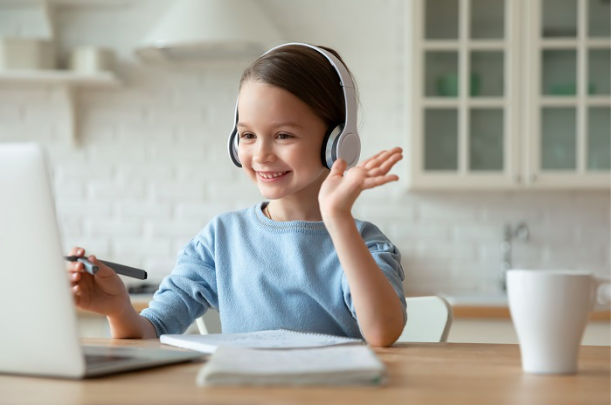
Teaching kids online comes with a whole set of challenges that in-person teachers never have to think about. Modern kids are already spending long hours staring at screens, so there’s no novelty factor when it comes to online classes. There are also countless distractions at home: siblings, pets, and toys are all readily available, something that isn’t true in an in-person classroom. Tech issues are also commonplace, and many times kids are unable to fix them on their own, leaving them dependent on having an adult nearby. Teachers of young children often rely on body language and proximity in order to get their students’ attention — tools that are limited or unavailable to an online teacher. Even if the student is seated in front of the computer with no distractions nearby, keeping their eyes from wandering is nearly impossible.
Practical Strategies for Teaching Kids Online and Keeping Them Engaged
So what are the best strategies for teaching kids online? There are numerous tools you can keep in your toolbox in order to keep your students engaged and learning:
- Use props and realia: Holding up a toy, a flashcard, or some other item immediately draws students’ attention.
- Build in movement: Antsy students will appreciate a round of Simon Says, point-to-it tasks, or TPR (Total Physical Response) activities.
- Vary the pace aggressively: By never spending more than 5–8 minutes on a task, you will always keep your students guessing about what will happen next.
- Use the child’s name frequently: It re-anchors attention and builds rapport.
- Use screen-sharing to your advantage: Any sort of video, image, or game will hold a child’s attention far better than speaking alone.
- Try a reward system: Virtual sticker charts, point trackers, or end-of-class “prizes” like a game or joke will give kids something to work towards.
Adapting Your Language and Classroom Management Style
If you’re used to teaching adults, you might find that the same language that motivates older learners falls flat when teaching kids online. For example, young learners do best with shorter, simpler instructions — not only because their English level is usually low, but also because children have trouble with complex directions even in their native language. Higher energy and expressiveness can also be a valuable tool for younger learners, since it gets them excited about their classes (although the opposite is true once the students get over 10 years old or so).
It’s also vital to set warm but firm expectations, so kids know what is and isn’t acceptable in the virtual classroom. These guidelines should be laid out early on, and consistent reminders are the best way to make them stick. Finally, communication with the parent or parents is always a good idea to keep everyone aligned. There’s no need to have parent-teacher conferences, but a quick check-in every once in a while to let them know how their child is doing will only help you as a teacher.

What Makes a Great Teacher of Young Learners
Not every great ESL teacher is a great young learner teacher — and that’s completely fine. Teaching kids online draws on a specific set of qualities that go beyond methodology: genuine playfulness, the kind of patience that survives a child spending three minutes trying to show you their hamster, and the creativity to pivot when a planned activity simply isn’t working. The best young learner teachers tend to find the funny side of a chaotic lesson rather than being derailed by it. If reading this post has felt energizing rather than exhausting, that’s a strong sign that teaching kids online might be exactly the right direction for you.
Teaching kids online is not a simplified version of adult ESL — it’s a speciality in its own right, and one that is as challenging as it is rewarding. The strategies and mindset shifts covered in this post are a starting point, but like any skill, they develop most quickly in a supportive environment with good feedback and real students to practise on. If you’re a playful, patient, and creative educator looking for a place to grow, we’d love to hear from you. At Craving, we work with a wide range of student profiles — including young learners — and we’re always looking for teachers who bring energy and professionalism to every session. Apply to join our team today!